Showing posts with label Startups. Show all posts

Sunday, February 22, 2015

Buzzfeed and LinkedIn go wide, but what about local news and commentary?

The Monday Note is one of the best media commentaries online. The two authors, Frédéric Filloux and Jean-Louis Gassée, have very intelligent and informed perspectives on legacy media and new technology. This week, they delved into the valuations of struggling old media companies (The New York Times et al) vs. unprofitable new media companies such as Buzzfeed, and the increasing visibility of social media companies such as LinkedIn in the news/commentary space (which many users access through the LinkedIn homepage).

One line that really jumped out at me was this one from Frédéric Filloux:

"The problem for legacy media is their inability to propose disruptive or scalable perspectives. Wherever we turn -- The NYT, The Guardian, Le Monde -- we see only a sad narrative based on incremental gains and cost-cutting. No game changing perspective, no compelling storytelling, no conquering posture. Instead, in most cases, the scenario is one of quietly managing an inevitable decline."

I wouldn't be so negative on the storytelling of publications such as The New York Times, but I agree with the sentiment that news publications are in decline. I realize this every time I look at my local paper, or certain sections of the Times, such as Business ... which at one time tried to compete with the Wall Street Journal. Now the Times has retrenched around its core national news/commentary/arts coverage while the second-tier sections limp along. 

One thing I would like to add: These companies -- and their digital competitors -- are playing in the national/international space. In local news/commentary, there are no players. AOL/Patch tried and failed. Can the big digital/social players such as Buzzfeed or LinkedIn find an effective way to go local?

LinkedIn commentary in the form of a user-created post

If you are interested in learning more about LinkedIn, my company has published a book about LinkedIn.

Wednesday, November 27, 2013

23andMe's CEO letter and the FDA crisis

I just received this email from the 23andMe's CEO:

Dear 23andMe Customers,

I wanted to reach out to you about the FDA letter that was sent to 23andMe last Friday.

It is absolutely critical that our consumers get high quality genetic data that they can trust. We have worked extensively with our lab partner to make sure that the results we return are accurate. We stand behind the data that we return to customers - but we recognize that the FDA needs to be convinced of the quality of our data as well.

23andMe has been working with the FDA to navigate the correct regulatory path for direct-to-consumer genetic tests. This is new territory, not just for 23andMe, but for the FDA as well. The FDA is an important partner for 23andMe and we will be working hard to move forward with them.

I apologize for the limited response to the questions many of you have raised regarding the letter and its implications for the service. We don't have the answers to all of those questions yet, but as we learn more we will update you.

I am committed to providing each of you with a trusted consumer product rooted in high quality data that adheres to the best scientific standards. All of us at 23andMe believe that genetic information can lead to healthier lives.

Thank you for your loyalty to 23andMe. Please refer to our 23andMe blog for updates on this process.

Anne Wojcicki
Co-founder and CEO, 23andMe

I am a 23andMe customer. I was attracted to the genetic testing service because the results can be used for genealogical research, but have since grown to appreciate the health insights. In fact, family members have ordered kits based on the reports that they saw were available. We have already received the results for one relative, but two others are awaiting testing.

The other valuable service provided by 23andMe is the community. There are a lot of online discussions about genealogical and health results, and even more importantly, it's possible to reach out to people who share some common genes that indicate relative status.

I think the FDA should be concerned about the accuracy of the testing, and the potential for false positives. But remember that 23andMe is also focused on data quality. In addition, 23andMe is very careful to provide peer-reviewed research and other vetted data to users of its service, when it comes into providing health insights. It also states that health-related concerns should be discussed with doctors and other health professionals.

In other words, 23andMe is not a DIY diagnosis service. It shows risks based on genetic profiles and public research, and advises people to seek out professional medical advice.

Thursday, February 28, 2013

Startup accelerators aren't for everyone

Today, I got a message from an old friend, asking about applying to startup accelerators. He recently left a job at a large Internet company for the startup life, and with his co-founder have begun to build some prototypes. They have also begun to consider startup accelerators like TechStars as a way to take their fledgling venture to the next level in a short period of time.

Here's what I told him: If you can get in, accelerator programs can bring wonderful benefits. You get some funding, mentors, office space, publicity, and access to experienced investors. The people I know who have made it into Y Combinator, MassChallenge, and TechStars are generally very positive about the experiences and the opportunities that came from being a part of these programs.

But here's the other thing: The application processes around some accelerators can be a huge distraction. My first startup applied to several accelerators in Boston, New York, and San Francisco, and made it to the interview stage of one of them. In the weeks before the scheduled interview, I found myself engaged in time-wasting activities such as writing emails to directors and various influencers every few days, lobbying companies that had gone through the program in years past, and spending time on things that could be construed as progress ("talked with a potential investor!", "discussed an opportunity in xyz!") to share in my email updates. These activities had little or nothing to do with progress on product or getting customers. Not only did we fail to get the nod from the accelerator, we wasted valuable time and effort on things that ultimately did not matter to the business.

I learned a lot from this and other experiences that ultimately led to the failure of the company. I also developed a belief that accelerators aren't for everyone. I have been running my second company, i30 Media, according to a different set of principles based on what I call a "Lean Media" framework. In addition, I have no interest in applying to accelerators. It's too distracting, and the needs of the company are different. I'm not looking for funding, which is the focus of many accelerator programs' "Demo Day". i30 Media is not only growing (Online Content Marketing In 30 Minutes, by author Derek Slater, was released at the beginning of this month) but it's also profitable. I see a path to growth and success that does not require the help of accelerators or VCs.

Nevertheless, accelerators are hugely important to some companies. I told my friend he was doing the right thing by learning how to code and experimenting with different online products. I suggested that he take one of these ideas to the next level in a very short period of time -- either by getting lots of traction on users (if it's consumer) or getting paid customers (enterprise/B2B). This is not only the type of progress that accelerators want to see, it's also vital for the future of the company, regardless of whether or not they end up participating in a startup accelerator.

Sunday, December 2, 2012

Reflections: Hacker News 10,000

A little over five years ago (1878 days ago, to be exact) I joined an online community called Hacker News. I don't remember how I heard about it, but I liked what I saw. The design was uncluttered, and the discussion was oriented toward programming, entrepreneurship, and other interesting topics which had a geeky/intellectual bent. From the Wayback Machine, You can see what it looked like in November 2007, which was shortly after I joined.

Importantly, the discussions themselves could be even more interesting than the links. There was a much higher signal/noise ratio in the Hacker News comments than in Slashdot, which until 2007 had been my daily forum of choice. Hacker News members tended to write "long", and even the short comments/questions tended to be thoughtful -- there was almost no trolling, flame wars, or crass one-liners that dominated Digg or Reddit. I have some discovered some standout contributors with strong expertise in startups, programming, and even the law. They include nirvana and grellas.

The quality of the discussion was so good, sometimes I found myself sharing the links to the Hacker News thread, or even writing about them on Computerworld and The Industry Standard, where I worked in the late 2000s.

I began to submit blog posts and articles from my places of work. The very first submission: Computerworld's DOS lives ... Secrets of the Windows command prompt. At IDG (the publisher of Computerworld and The Industry Standard) we were very familiar with the Slashot effect. I quickly discovered that Hacker News did not have the audience of Slashdot, but sometimes there would be a few hundred visitors and some good comments (usually left on Hacker News, not the post/article).

Over time I began to diversify my submissions. By 2009/2010, I was submitting only those articles that A) reflected the news/discussions sources I read most often and B) would be interesting to the Hacker News audience. I submitted 1306 articles and posts in all. Almost all submissions died on the vine, but some resonated. A few received hundreds of upvotes and scores of comments.

For instance, last week I spotted an interesting item in the Chronicle of Higher Education e-newsletter about Salman Khan, the entrepreneur behind Khan Academy. The Hacker News community holds Khan in high regard, partially because of his background (MIT, strong in math and science), but mostly because he has disrupted online learning. I submitted the latest news about Khan's new proposal for higher education, and it received more than 200 upvotes and about 90 comments. It was this submission that pushed me over 10,000 upvotes/points/karma/whatever it's called.

I left very few comments on Hacker News in the beginning. I felt that I didn't have the deep expertise to contribute to most discussions ... and didn't have the time to participate. The exceptions were discussions about online media and some historical topics, or those topics which allowed me to do a little research to add a fact or pose a relevant question. Over five years, I estimate I have made between 100 and 200 comments. Most have only an upvote or two. You can read them here.

There have been other interactions with Hacker News and Y Combinator. A few times I have reached out to other commenters for various reasons -- to use as story sources, or, when I started my first company, I wanted to learn from others in that space. Sometimes, people have contacted me (I leave my Twitter/email information in my profile).

There was another interaction that is worth mentioning. In 2008, I reached out to Paul, who put me in touch with Jessica. By this time, I was familiar with his essays (and Jessica's great interviews in Founders At Work). I was working for The Industry Standard, and wanted to see the Y Combinator accelerator in action. They invited me to their summer headquarters in Cambridge. This was the last year they came to Cambridge. It was great. Jessica was very helpful -- the idea was to make the introductions to the startups, and get out of the way. The space was small (I think there were only a dozen or so teams) but that was alright -- there was a very family-like feeling to the cohort, and I had some great interviews with the founders. Afterwards, a guest speaker came and talked about his observations. I am going to keep my word to Paul and not reveal the identity of the speaker or what the guest speaker talked about.

My final observations concern how Hacker News has changed since 2007.

Certainly, more people are using it, and the front page threads are a lot longer. In the past, there have been discussions about how HN is becoming more like Reddit or the discussion is becoming ruder or more critical. I agree.

Nevertheless, I think the front-page links are great, and the discussions they spawn are almost always thought-provoking. I learn something new every day, and try to make positive contributions from time to time.

Here's to five more years and 10,000 more points ...

Hacker News 10,000

Friday, November 9, 2012

The Lean Media mindset: Can it work for large companies?

Since the failure of my first software startup and the early traction of my latest digital publishing venture, I've been thinking a lot about how to make successful media products in the digital age. I have come to believe that Lean methodologies used in software development can also be applied to media ... but require some modifications in order to accommodate certain characteristics of the media industry.

My thinking about Lean Media actually goes back to the 2000s, long before I even heard the term "Lean". In the 2000s, I was responsible for managing and developing new media products for large organizations -- Harvard University and IDG. One of my takeaways from these experiences was that small, independent teams with a willingness to rapidly create and develop content and new products (special feature, website, online community, etc.) could enjoy small successes as well as the occasional hit. Where these efforts suffered was in the follow-up ... responding to user feedback cycles and taking the nascent products to the next level. This was often an issue of insufficient resources, as well as directives from the center of the organization to concentrate efforts somewhere else.

In addition, I have observed that few traditional media companies are structured to operate in such a fashion. Even if the resources are available to prototype, the mandate to have an independent team work on these types of projects may not be there. Indeed, the idea of letting audiences see a raw, unfinished product may seem like heresy to executives obsessed with polished designs and powerful brands. The expectation for new products is they look and feel as professional and established as a big brand.

What I am trying to do now is develop a framework for Lean Media that both startups and large organizations can use for product development. My blog post titled "A proposal for a Lean Media Framework: Input and iteration required", describes how I am approaching the problem:

... When I started my second venture this summer, the ebook experiment, I pledged to myself that I would attempt to actively follow the Lean philosophy. Get products out to the marketplace as soon as possible. Measure. Iterate. Improve. Some of these processes were already ingrained, owing to my earlier experiences with rapid product development in the online media and music industries, as well as the mobile software startup, and my grad school experience, which emphasized iterative product development. But I was more methodical with measuring and incorporating feedback. I also paid a lot of attention to revenue, something that I had not been focused on with any previous venture or media experiment.

As the ebook venture progresses, my mind has been circling back to the inconsistencies I observed earlier. Yes, Lean methodologies do work for media content. They can lead to better products, and better sales. However, the Lean approach does not take into account important factors — such as brand and creative processes — that can determine the success or failure of media ventures.

Therefore, I believe there is an opportunity to build a new Lean framework that is specific to media ventures — a Lean “mod” for media, if you will. The goal of building a Lean Media Framework is to help startups and established companies build innovative products, platforms, and business models that have a higher chance of success and can contribute to new models of creation, distribution, and consumption.

If you are interested in helping me develop this idea, let's have a discussion. Feel free to leave comments below or contact me using the email address on this page.

Thursday, July 26, 2012

A warning to new ebook authors: Don't believe the hype


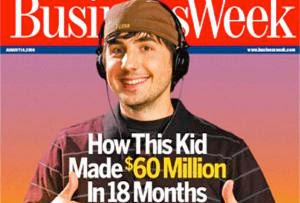
One thing I've learned as a veteran of the online publishing world and app store rat race is MSM journalists love to tell stories of the runaway successes by beginners. To give you an example, check out the inset BusinessWeek cover from 2006, "How this kid made $60 million in 18 months".

ebook hype

The young man on the cover of BusinessWeek is Kevin Rose, founder of Digg. He left his company a few years ago. He may have taken some money along the way, but it sure as heck wasn't $60 million. Digg was sold earlier this month for just $500,000.

If you look at Forbes, CNN, USA Today and other mainstream media outlets, you'll see the same types of attention-grabbing headlines. These articles do a great disservice, and lead to the following trends:

  • They make the public at large think anyone with products in these platforms are bound to be successful
  • They lead potential developers/content creators to think that it's a cinch for newcomers to become multimillionaires
  • They encourage large companies to think that they need to have a presence in these platforms

The result? Enormous hype cycles (anyone remember the scores of multinational companies rushing into Second Life?). Loads of "me-too" products and companies ("it's like Angry Birds ... but with cats!"). Unrealistic expectations ("all we need to do is grab 5% of the market and ..."). And bubbles (BitCoins, anyone?).

The same hype cycle has been building for ebooks. It's not just 50 Shades Of Gray, either. There's this Atlantic article trumpeting the fact that a technical review repurposed for ebooks sold 3,000 copies on the first day.

I recently published my first ebook, "Dropbox In 30 Minutes." A warning to anyone who expects thousands of downloads on the first day: Unless you are a brand or have the marketing commitment of a major online brand like Ars (the publisher of the technical ebook), you'll be lucky to get a few downloads per day. Yes, it's possible to raise those numbers on your own, but only through lots of hard work (writing quality content, marketing, etc.) and a huge dose of luck.

So, mainstream media journalists reading my blog post: Do your readers a favor, and be very careful with anecdotes of success in the digital media world.

And my message to potential ebook authors: Don't believe the hype.

Friday, February 24, 2012

Getting close to launching our app

We're getting close to launching the Invantory app for iOS mobile devices. What does the app do? Well, the first iteration is aimed at making it easy for people to buy on Craigslist with an iPhone or iPad. Here's a screenshot of what a classifieds listing looks like:

guitar classifieds

This looks a lot different than what you typically see on the PC/Web version of Craigslist. In addition, the experience of browsing listings on a mobile device using Invantory is really unique. Instead of looking at text lists and using search engines, the focus is on photos. This helps people quickly determine what is of interest, and also helps them evaluate quality.

Future versions of the Invantory Craigslist app will do lots of other things, including creating classifieds and distributing the listings elsewhere.

Has it been tough building an app? For my partner Sam, it has been extremely time-consuming, with many technical hurdles to overcome. Are we nervous about the launch? Absolutely. Are there ups and downs associated with running a startup? Every week I am on a startup roller coaster. But nevertheless we are making progress and are really looking forward to what matters: Whether or not people will like using the app. We hope you can try the app and let us know. Download the app via the Invantory website, or sign up to be notified by email when it launches.

Sunday, December 25, 2011

500,000 page views

Last month, one of my blogs passed a major milestone: 500,000 page views. The Statcounter report is here:
500,000 page views for my blog
Some other relevant data about this figure: Statcounter has been measuring traffic on that blog since 2005 or 2006. I have been also running Google Analytics on the same blog, but it shows a lower figure -- about 400,000 page views for the same period but still shows about a quarter-million unique visitors (differences between the two tools are shown here). I've generated several thousand dollars in AdSense revenue from the blog over the years -- not enough to live on, but a welcome addition these days considering I have no other income from the classifieds startup that I cofounded.

These numbers may not be impressive. After all, some blogs may get that much Web traffic in a single month. But what I find so interesting is that well over half the traffic to Harvard Extended has come to the blog after I stopped updating it in late 2008. In other words, people still find great value in content that's between three and six years old. It may not be "fresh", but it's deep and relevant and useful to them (average time spent by each visitor is more than 90 seconds, according to Google Analytics).

Google, of course, has helped bring most of this traffic, either directly through search or indirectly through references from other blogs or news sites that were originally sourced via search. But there are also people who have bookmarked it, or know about it through reputation and remember the URL.

Wednesday, October 5, 2011

Steve Jobs' star

Yesterday I was thinking about Steve Jobs, and the fact that he wasn't even mentioned at yesterday's iPhone event in Cupertino. Now we know why.

People who knew him will be able to eulogize his passing better than I can, but I did want to say that he has touched my life since the earliest days I was involved in computing. At my middle school in the early 80s, we had a computer room set up with Apple II+ and Apple IIe computers. It was on those machines that I first began to learn how to program, which set up a life-long affair with hardware, software and digital media that continues to this day.

It didn't stop with that early Apple experience. Eight years ago I got back into Apple's products through my "half dome" iMac on which I spent many late nights running remote database queries and writing a graduate thesis. An early iPod classic provided the soundtrack to my morning and evening commutes, and more recently I have treasured my iPod touch, which has really let me improve my life and connect with people in ways that I never could have imagined just a decade ago. With this remarkable little device, I was even able to take a two-week international trip without lugging along a laptop, as I have done during earlier overseas trips. The iTouch handled email, news, gaming, utilities, photos, twitter, Facebook, and even Skype. It was on this trip that I realized that we really are transitioning to a post-PC world, and Steve Jobs is directly responsible.

Last month I attended the dedication of Steve's star on the Entrepreneur Walk of Fame in Kendall Square, not far from MIT's campus. Journalist Dan Lyons (who famously created the parody blog "Fake Steve Jobs")  came up to the podium to give a short dedication. The MIT Entrepreneur Center's Bill Aulet noted Lyons was reluctant to do so, as Steve was known to be in grave health. Lyons spoke to the small crowd, remarking that while Jobs had stepped down from running the company, he insisted on remaining as chairman of the board.  "Even now, in his very poor, slipping health, he can not let go of Apple," Lyons said. "He has literally given his life to his vision." Lyons added that Jobs was unafraid to have his company cannibalize its own products, in the name of progress and creating great things.

I'd like to end this post with the engraving from Jobs' star in Cambridge. It reads:
"Being the richest man in the cemetery doesn't matter to me ... Going to bed at night, saying we've done something wonderful... that's what matters to me."
RIP, Steve.

Thursday, September 22, 2011

Website development and the importance of technical cofounders

(Update: Since writing this post, I have launched a company which is dedicated to helping people understand complicated technologies and concepts. Besides creating online posts which address questions such as What Is Dropbox and What Is Google Drive, I have also published a series of guides under the In 30 Minutes brand.)

An acquaintance recently contacted me about an idea for a Web startup, using social media to bringing together people interested in humanitarian causes, art, positive change, etc. The problem she had, and it's a problem that I think is quite widespread, is she doesn't have the required coding skills. I responded with the following message:
Regarding your idea for a social media site (or network?) it sounds pretty interesting, and there are definitely niches out there that are not being well served by Facebook, Linkedin Groups, or existing Web forums. 
That being said, I would be very careful about what area you target, as there are many existing services that address some of the areas that you named below -- Jumo, http://www.humanitarianforum.org/, some specific art-oriented communities, etc. Convincing users to join your site when there are already compelling services out there with large user communities is more difficult than targeting an unserved or underserved population. 
In addition, in my experience creating user communities and blogs in the past, I have found that very tight niches ("South Florida Artists for Peace") are much easier to gain traction than broad communities ("Worldwide Artists for Positive Change and Humanitarian Causes"). 
As for the nuts and bolts of creating the community, the good news is that there are many existing software platforms out there that make it much easier to get started, and good coders will know how to use them. 
The bad news is that good coders can be hard to find -- there is definitely a shortage of engineering talent, and you will be competing against larger companies and funded startups for them. 
But there is a silver lining: There are many software developers who are currently working as employees who are interested in co-founding a company. The question then arises of how to find one who likes your idea, recognizes the skills/connections you are bringing to the table, can brainstorm/collaborate on how to move the project forward, and finds the opportunity worth pursuing. 
In my opinion, the co-founder has to be someone you can meet in person on a regular basis -- that's how trust gets built, and ideas can move forward much more quickly than by sending emails or relying on Skype. You can work your local networks, or start attending local entrepreneurial meetups (preferably technology-oriented events). If there are none in your area, try organizing one and bring in one or two speakers that startup founders would want to hear from (for instance, a local lawyer talking about LLC vs S-Corp formation, or someone who has founded a successful startup in the past). 
Plan B would involve outsourcing all of the coding using Guru.com, Elance, or remote developers recommended to you by someone else. The problem with this approach, besides the cost, is working out the software specifications and deliverables can be very frustrating if you've never done it before. It's possible to find developers who can help walk you through the process, but even still the chance for misunderstandings and "scope creep" is very high -- another reason to find a technical co-founder.
I didn't get into the details of some of the software components that could be used to make such a site, but when I heard the idea I immediately thought of open-source content-management systems such as Joomla and Drupal, and authentication tools such as Facebook Connect and Twitter's xAuth/OAuth that would let people use their existing social media identities to authenticate/register and easily distribute the site's content and discussions elsewhere.